Cross-Border Shipping Canada US: What Every Canadian Business Needs to Know in 2026
Last updated: May 20, 2026
Quick Answer: Cross-border shipping between Canada and the US requires proper customs documentation, an understanding of CUSMA/USMCA rules of origin, and a clear grasp of current tariff conditions. In 2026, tighter origin audits, a proposed CBSA valuation change, and ongoing steel and aluminum tariffs are making compliance more demanding than it was even 12 months ago. Getting the paperwork right before your freight hits the border is the single most effective way to avoid delays and unexpected costs.
Key Takeaways
- Documentation is non-negotiable. A commercial invoice, bill of lading, packing list, and certificate of origin are the baseline for most cross-border shipments.
- CUSMA (USMCA) preferential duty rates are not automatic. You must prove rules of origin with a valid certificate — and origin audits are tightening in 2026. [8]
- US-Canada freight totalled USD $712.8 billion in 2025, down 6.4% year-over-year, reflecting the real impact of trade tensions and tariffs on cross-border volumes.
- Tariffs on steel, aluminum, and certain motor vehicles remain in place in both directions, even after Canada lifted its broad 25% surtax on USMCA-compliant goods in September 2025. [8]
- CBSA’s proposed “last sale” valuation rule is a major cost risk for e-commerce sellers and non-resident importers shipping into Canada — review your landed cost model now. [7]
- A customs broker and a freight forwarder are not the same thing. You likely need both for cross-border shipments.
- The de minimis threshold differs significantly between Canada (CAD $20 for duties, CAD $40 for taxes) and the US (USD $800).
- The USMCA joint review, due by July 1, 2026, adds strategic uncertainty — rules of origin and sector-specific tariffs could shift.
- Border delays are almost always documentation problems. Incomplete or inconsistent paperwork is the top cause of held freight.
- Working with a third-party logistics (3PL) provider that specializes in Canada-US lanes can dramatically reduce compliance risk for smaller shippers.
What Documents Do You Need for Cross-Border Shipping Between Canada and the US?
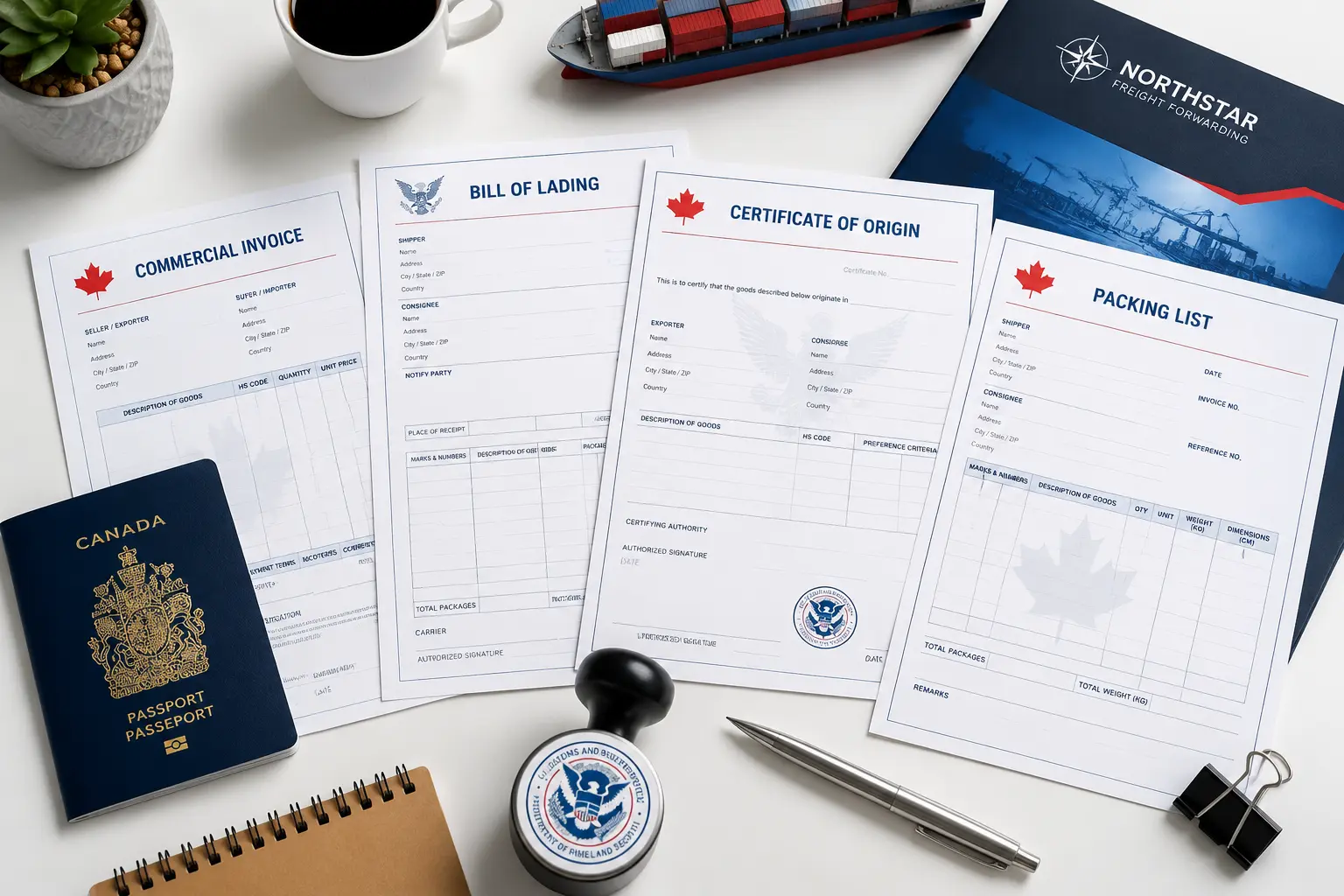
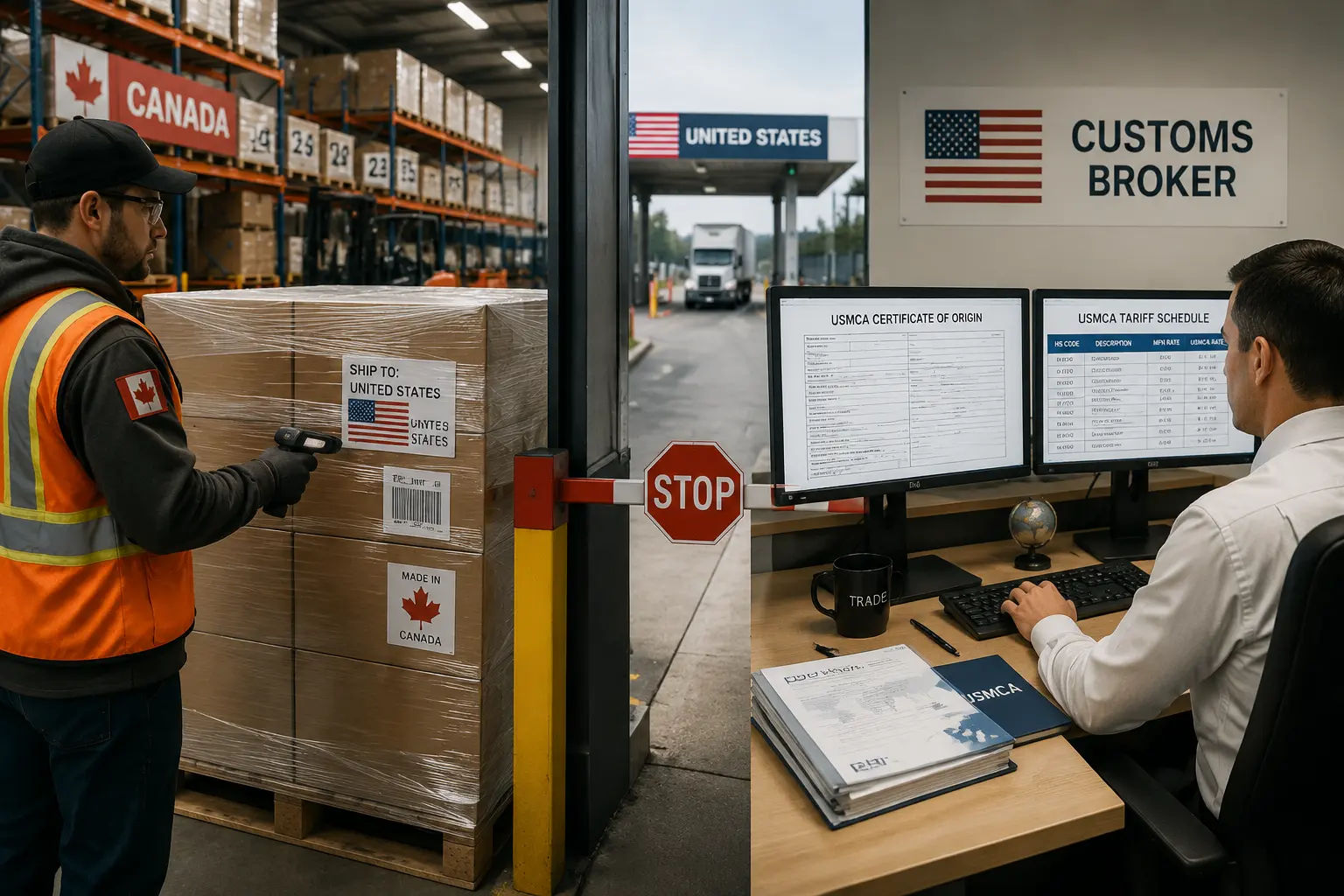
Every cross-border shipment between Canada and the US needs a core set of documents. Missing even one can stop your freight at the border.
Here’s what’s required for most commercial shipments:
Standard documents for Canada-US cross-border shipping:
| Document | Purpose | Who Prepares It |
|---|---|---|
| Commercial Invoice | Declares goods, value, and parties | Exporter/Seller |
| Bill of Lading (BOL) | Contract between shipper and carrier | Carrier or Freight Forwarder |
| Packing List | Itemizes contents, weights, dimensions | Exporter/Seller |
| Certificate of Origin | Confirms CUSMA/USMCA eligibility | Exporter/Producer |
| Customs Entry (B3 into Canada / CBP Entry into US) | Formal import declaration | Customs Broker |
| NAFTA/CUSMA Certificate (if claiming preference) | Proves rules of origin compliance | Exporter/Producer |
For specific goods, you may also need:
- Canada Food Inspection Agency (CFIA) permits for food, plants, or animals
- Health Canada permits for controlled substances or medical devices
- Export permits for controlled goods (military, dual-use technology)
- Shipper’s Export Declaration (SED) for US exports above USD $2,500
Common mistake: Many first-time cross-border shippers undervalue goods on the commercial invoice to reduce duties. CBSA and US Customs and Border Protection (CBP) both flag undervaluation, and the penalties — including seizure — are far more expensive than the duties you were trying to avoid. [4]
How Do CUSMA (USMCA) Rules of Origin Affect Your Cross-Border Shipments?
CUSMA (Canada’s name for the USMCA, also called the Canada-United States-Mexico Agreement) allows qualifying goods to move between Canada, the US, and Mexico at reduced or zero duty rates. But “qualifying” is the key word — and it requires proof.
Rules of origin define how much of a product must be made or processed within North America to receive preferential tariff treatment. The thresholds vary by product category, but the general principle is that goods must undergo sufficient transformation in a CUSMA country.
What’s changing in 2026:
Origin audits are tightening. A certificate of origin that passed review in 2024 may not survive scrutiny now. [8] CBSA and CBP are both increasing verification activity ahead of the USMCA joint review, which must be completed by July 1, 2026. That review could renegotiate rules of origin for specific sectors, including automotive, steel, and aluminum.
Practical steps to protect your CUSMA eligibility:
- Audit your supply chain — know exactly where each component originates
- Keep supporting records for at least five years (supplier declarations, production records, cost breakdowns)
- Review certificates before each shipment — don’t reuse old certificates without verifying they’re still accurate
- Work with a customs broker who actively monitors CUSMA classification changes
- Don’t assume that because your product qualified last year, it qualifies today
Choose CUSMA certification if: Your goods are manufactured substantially in Canada, the US, or Mexico and you have documentation to prove it. If your supply chain includes significant non-North American content, get a trade lawyer or customs broker to assess your exposure before claiming preferential rates. [5]
What’s the Difference Between a Customs Broker and a Freight Forwarder?
These two roles are often confused, but they serve very different functions in cross-border shipping.
Customs broker: A licensed professional who handles the legal import/export declaration process with CBSA (in Canada) or CBP (in the US). They classify your goods under the correct tariff codes, calculate duties and taxes, and submit the official entry documents on your behalf. In Canada, customs brokers must be licensed by CBSA.
Freight forwarder: A logistics coordinator who arranges the physical movement of your shipment — booking carriers, managing documentation flow, coordinating pickups and deliveries, and sometimes providing warehousing solutions or order fulfillment services along the route.
The key distinction:
- A customs broker handles compliance and clearance
- A freight forwarder handles movement and coordination
Some companies offer both services under one roof. For most small and mid-sized Canadian businesses doing regular cross-border shipping, working with a provider that combines freight forwarding and customs clearance is the most efficient approach — fewer handoffs, fewer communication gaps. [5]
Edge case: If you’re shipping high-value, regulated, or time-sensitive goods (pharmaceuticals, electronics, perishables requiring cold chain logistics), use specialists for each function. The cost of a clearance error on a $200,000 shipment far exceeds the savings from bundling services with a generalist.
How Are US Tariffs and Trade Tensions Affecting Canadian Businesses in 2026?
The short answer: significantly, and the situation is still evolving.
US-Canada freight totalled USD $712.8 billion in 2025, down 6.4% from 2024 — a real contraction driven by tariff uncertainty and trade tensions. Tariffs on steel, aluminum, and certain motor vehicles remain in place in both directions as of mid-2026. [8] Canada lifted its broad 25% surtax on USMCA-compliant goods in September 2025, but sector-specific tariffs remain a live issue. [6] [8]
What Canadian businesses are dealing with right now:
- Steel and aluminum tariffs continue to raise input costs for manufacturers on both sides of the border
- Retaliatory tariff risk hasn’t fully disappeared — Canadian exporters should monitor federal trade policy announcements closely
- Spot truckload rates on Canada-US lanes are firmer year-over-year, partly driven by tighter capacity and steady cross-border demand
- The USMCA joint review (due July 1, 2026) could alter duty-free treatment for specific product categories — automotive parts, dairy, and digital trade are all on the table
Practical responses for Canadian exporters and importers:
- Diversify carrier relationships so you’re not locked into one trucking company if rates spike
- Build tariff cost scenarios into your pricing model — assume tariffs could increase, not decrease
- Engage a trade advisor before the USMCA review concludes, especially if your product category is politically sensitive
- Consider bonded warehousing near the border to defer duty payments and maintain flexibility [10]
Pull quote: “Assume more aggressive use of trade remedies and origin challenges through and after the 2026 USMCA review.” — Trade strategy guidance from cross-border legal advisors [8]
What Is the De Minimis Threshold for Canada-US Cross-Border Shipments?
The de minimis threshold is the value below which goods can enter a country without formal customs entry or duty payment. The gap between Canada and the US is substantial — and it matters a lot for e-commerce sellers.
| Country | De Minimis (Duties) | De Minimis (Taxes) |
|---|---|---|
| Canada | CAD $20 | CAD $40 |
| United States | USD $800 | USD $800 |
The US threshold of USD $800 is among the highest in the world and has historically made direct-to-consumer shipping from Canada into the US relatively accessible for small e-commerce sellers. [2] [3]
Canada’s CAD $20 threshold is extremely low by international standards. In practice, this means almost all commercial shipments from the US into Canada — including e-commerce orders — are subject to duties and taxes. [4]
Why this matters more in 2026:
CBSA’s proposed “last sale” valuation rule would change how duties are calculated on imports into Canada. Instead of basing duties on the upstream cost of goods, CBSA would calculate duties on the final sale price paid by the Canadian buyer. [7] This is a significant cost increase for US-based e-commerce sellers shipping direct-to-consumer into Canada, and for non-resident importers using low upstream valuations to minimize duties.
If you’re a US seller shipping into Canada:
- Recalculate your landed costs using the retail sale price as the dutiable value
- Consider whether establishing a genuine Canadian distribution presence (with real personnel, assets, and Canadian tax filings) makes financial sense — this may allow continued use of cost-based valuation under CBSA’s “substantial presence” test [7]
- Alternatively, importing speculative inventory (stock brought into Canada without pre-arranged sales) may allow valuation based on acquisition cost rather than retail price in certain scenarios [7]
What Causes Delays at the Canada-US Border — and How Do You Avoid Them?
Border delays cost money. A truck sitting at the border for four hours is four hours of driver time, carrier cost, and potentially spoiled product if you’re running cold chain logistics.
The most common causes of cross-border shipping delays:
- Incomplete or incorrect documentation — wrong HS tariff codes, missing commercial invoice details, or a certificate of origin that doesn’t match the shipment
- Undervalued or misdescribed goods — triggers secondary inspection
- Restricted or regulated products — food, plants, chemicals, and electronics often need permits that weren’t obtained in advance
- Driver or carrier compliance issues — carriers must be registered with CBSA’s Customs Self Assessment (CSA) program or CBP’s FAST program for expedited processing
- Random secondary inspections — unavoidable, but less likely with a clean compliance history
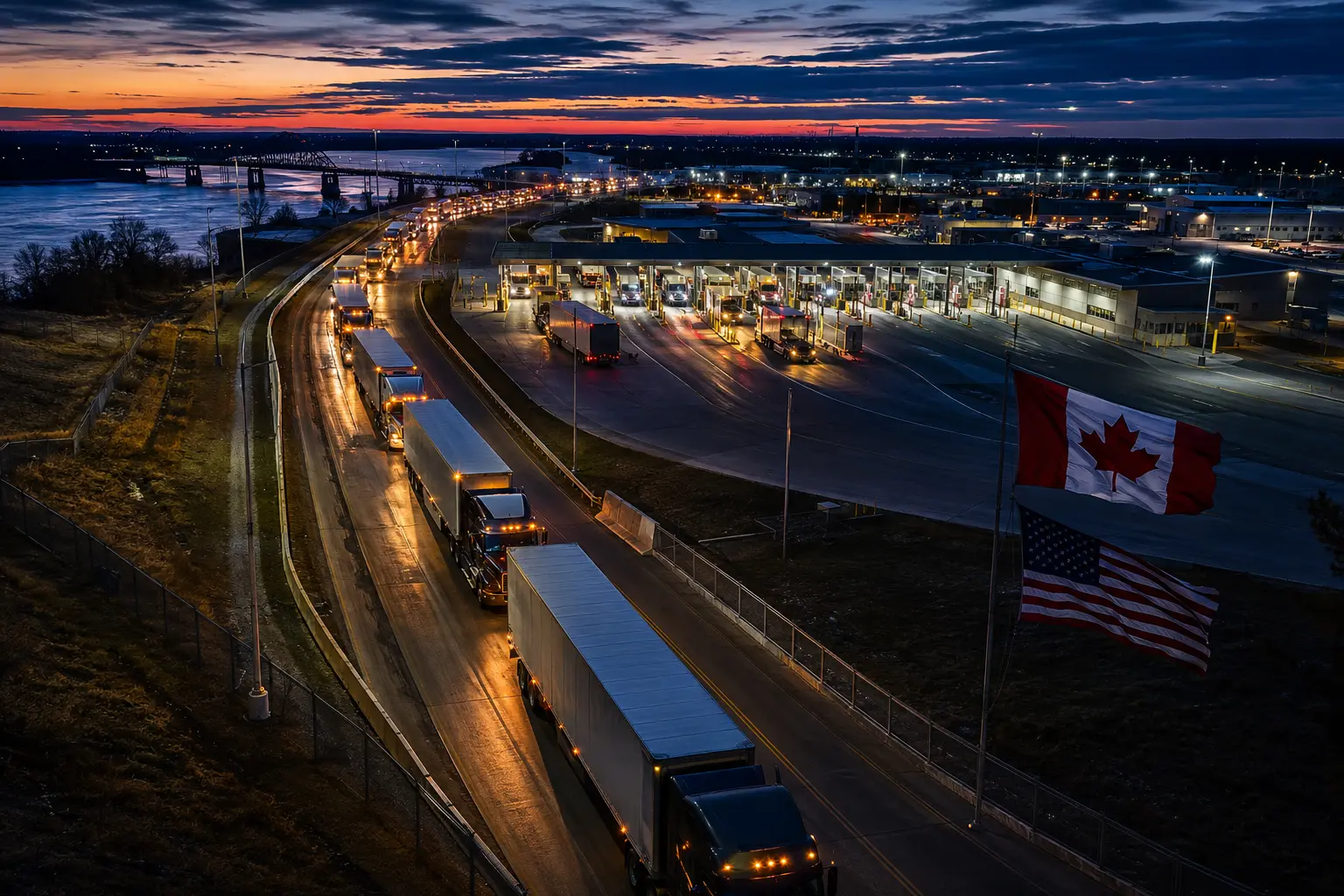
- System outages or peak congestion — major crossings like Windsor-Detroit, Lacolle-Champlain, and Pacific Highway can back up significantly during peak hours
How to reduce delay risk:
- File your customs entry electronically before the shipment arrives at the border (pre-arrival processing is available through CBSA’s ACI program)
- Use carriers enrolled in the FAST (Free and Secure Trade) program
- Work with a customs broker who reviews documentation before the truck departs, not after it’s already held
- Maintain consistent descriptions across all documents — the invoice, packing list, and BOL must all match
How Do You Choose the Right Logistics Provider for Canada-US Cross-Border Shipping?
Not every logistics provider is set up for cross-border work. Domestic shipping expertise doesn’t automatically translate to Canada-US freight competence.
What to look for in a cross-border logistics partner:
- Licensed customs brokerage (or a strong brokerage partner relationship)
- Experience with your specific commodity type — food, industrial goods, and consumer products each have different regulatory requirements
- Carrier network on both sides of the border — a provider with strong Canadian domestic reach but limited US connections will create handoff problems
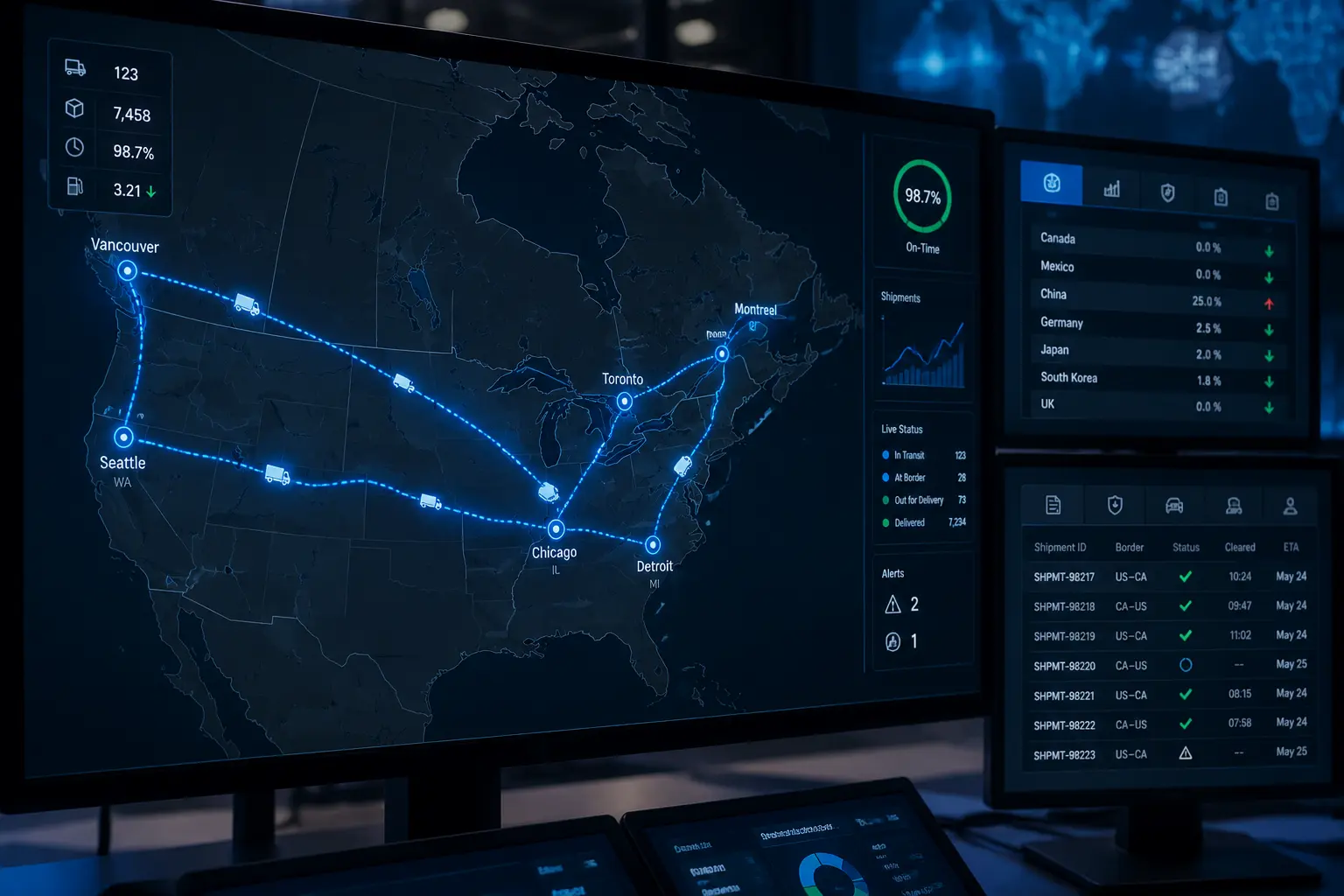
- Cargo tracking capability — real-time visibility is table stakes for cross-border shipments
- Familiarity with CUSMA/USMCA documentation — this is where inexperienced providers make costly mistakes
Choose a 3PL (third-party logistics provider) if:
- You’re shipping regularly but don’t have the volume to justify in-house customs staff
- Your product mix is complex or changes frequently
- You want one point of contact for freight forwarding, customs clearance, and last-mile delivery
Manage it in-house if:
- You have dedicated trade compliance staff with CUSMA expertise
- Your shipments are high-volume, standardized, and use the same tariff codes consistently
Frequently Asked Questions
Q: Do I need a customs broker for every Canada-US shipment?
Technically no — importers can self-clear goods. But for commercial shipments, the classification complexity, liability exposure, and time cost make a licensed customs broker worth the fee for most businesses. [4]
Q: What is the CUSMA certificate of origin, and who signs it?
It’s a self-certified declaration by the exporter or producer confirming that goods meet CUSMA rules of origin. There’s no official government form required — a statement on the commercial invoice is acceptable — but the content must meet specific requirements set out in the agreement. [5]
Q: Can I ship goods to the US without paying US duties if I’m a Canadian business?
If your goods qualify under CUSMA rules of origin and you provide a valid certificate, many goods enter the US duty-free. But tariffs on steel, aluminum, and certain other products apply regardless of CUSMA status. [8]
Q: What’s the CBSA “last sale” rule and does it affect me?
CBSA is proposing to calculate import duties based on the final sale price to the Canadian buyer, not the upstream cost of goods. This primarily affects US-based e-commerce sellers and non-resident importers who currently use lower upstream values to calculate duties. If you sell direct-to-consumer into Canada from the US, this likely affects your landed cost model. [7]
Q: How long does customs clearance take at the Canada-US border?
For pre-approved, electronically filed shipments with clean documentation, clearance can happen in minutes. Secondary inspections can take hours. Shipments with missing documents can be held for days. [5]
Q: What’s the difference between an HS code and a tariff classification?
They’re the same thing. The Harmonized System (HS) code is the international product classification number used by customs authorities worldwide to determine applicable duties and regulations. Getting this wrong is one of the most common — and costly — mistakes in cross-border shipping.
Q: Are there size or weight restrictions for cross-border truck shipments?
Yes, and they differ by province and state. Canadian provinces have varying weight limits, and some US states have different axle weight rules. Your carrier should know the applicable limits for your specific route.
Q: What happens if my goods are seized at the border?
You’ll receive a seizure notice from CBSA or CBP. You can pay a penalty to have goods released, or contest the seizure through a formal review process. Either way, it’s expensive and time-consuming — prevention through proper documentation is far cheaper.
Q: Do I need cargo insurance for cross-border shipments?
Carrier liability is limited by law and rarely covers the full value of your goods. Cargo insurance is strongly recommended for any shipment with meaningful value.
Q: What is the FAST program and should my carrier use it?
FAST (Free and Secure Trade) is a joint Canada-US program that allows pre-approved importers, carriers, and drivers to use dedicated lanes and expedited processing at the border. If you ship regularly, enrolling your carrier in FAST is one of the most effective ways to reduce border wait times.
Conclusion: Your Next Steps for Smarter Cross-Border Shipping
Cross-border shipping between Canada and the US has always required attention to detail. In 2026, the stakes are higher — tighter origin audits, evolving tariff conditions, a proposed CBSA valuation change, and the looming USMCA joint review all add layers of complexity that weren’t there two years ago.
The businesses that handle this well aren’t necessarily the biggest ones. They’re the ones with clean documentation practices, the right logistics partners, and a habit of staying current on regulatory changes.
Your immediate action list:
- Audit your current documentation process — does every shipment go out with a complete, consistent set of documents?
- Review your CUSMA certificates of origin — are they still accurate given your current supply chain?
- Recalculate your Canada-bound landed costs using retail sale price as the dutiable value, in anticipation of CBSA’s “last sale” rule
- Confirm your carrier is FAST-enrolled for cross-border lanes
- Find a licensed customs broker if you don’t already have one — this is not an area to wing it
If you’re looking for customs brokers, freight forwarders, 3PL providers, or trucking companies that specialize in Canada-US cross-border shipping, LogisticsSearch.ca is built exactly for that — a searchable directory of Canadian logistics providers, organized so you can find the right partner for your lane, commodity, and volume without spending hours on Google.
References
[1] Cross Border Shipping Guide – https://www.whyloyalty.com/blog/cross-border-shipping-guide/
[2] Cross Border Shipping – https://redstagfulfillment.com/cross-border-shipping/
[3] Shipping To Canada From The US – https://goshippo.com/blog/shipping-to-canada-from-the-us
[4] Cross Border Shipping Regulations – https://www.eshipper.com/blog/cross-border-shipping-regulations/
[5] Canada US Cross Border Shipping Guide 2026 – https://tmfreightgroup.com/blog/canada-us-cross-border-shipping-guide-2026
[6] New 25% Tariffs On US Products Effective March 13 2025 – https://www.buckland.com/news/new-25-tariffs-on-u-s-products-effective-march-13-2025/
[7] Canada Last Sale Rule – https://passportglobal.com/blog/https-passportglobal-com-blog-canada-last-sale-rule/
[8] US Canada Cross Border Freight In 2026: New Rules, Tariff Impact And What To Prepare – https://www.goship.com/blog/us-canada-cross-border-freight-in-2026-new-rules-tariff-impact-and-what-to-prepare/
[10] How Your International Trade Can Survive And Thrive In 2026 – https://www.pcb.ca/post/how-your-international-trade-can-survive-and-thrive-in-2026