The Best 3PL Providers in Canada for Small and Mid-Sized Businesses (2026 Guide)
Last updated: May 20, 2026
Quick Answer: A third-party logistics (3PL) provider handles warehousing, order fulfillment, and shipping on your behalf — so you can stop running a warehouse and focus on growing your business. For Canadian small and mid-sized businesses (SMBs), the best 3PL isn’t the biggest one; it’s the one that fits your sales channels, order volume, and geography. This guide breaks down how to find that fit.
Key Takeaways
- A 3PL manages your warehousing, picking, packing, and shipping — you stay focused on sales and product.
- The Canadian 3PL market is growing, with providers increasingly offering dual-hub strategies (Toronto + Vancouver) to reach most of the country within two days.
- Cost structures vary widely: expect receiving fees, storage fees (per pallet or bin), pick-and-pack fees, and outbound shipping — always compare total landed cost, not just one line item.
- The right time to switch to a 3PL is usually when fulfillment is eating more than 20% of your team’s time or when shipping errors are hurting customer retention.
- Technology integration matters as much as warehouse location — your 3PL should connect directly with your Shopify, WooCommerce, or ERP system.
- Cross-border shipments into Canada require complete customs data per order; choose a 3PL with strong compliance workflows if you’re importing. [CBSA]
- Amazon FBA is not a substitute for a dedicated Canadian 3PL — especially after the 2026 fee changes that added a 3.5% fuel surcharge for Canadian sellers.
- The most common mistake SMBs make is choosing a 3PL on price alone, then discovering hidden fees or poor carrier relationships after signing.
What Is a 3PL Provider and How Does It Work in Canada?
A third-party logistics provider is a company that stores your inventory and ships orders on your behalf. You send your products to their warehouse; they pick, pack, and ship each order as it comes in through your sales channels.
In Canada, the 3PL model works the same way as anywhere else — but geography adds a layer of complexity. Canada is the second-largest country in the world by land area, and shipping from a single warehouse in Ontario means slower, more expensive delivery to British Columbia or the Atlantic provinces. That’s why many Canadian 3PL providers now operate multi-node networks, with distribution centers in at least two major cities. [3]
Here’s the basic flow:
- You ship bulk inventory to the 3PL’s warehouse (called “inbounding”).
- The 3PL stores your products and tracks inventory in real time.
- A customer places an order on your website or marketplace.
- The 3PL receives the order automatically (via software integration), picks the items, packs the box, and ships it.
- You and your customer both get tracking information.
The 3PL bills you for storage space used, the labor to pick and pack each order, and the outbound shipping (usually at negotiated carrier rates). [8]
The key distinction: You own the inventory and the customer relationship. The 3PL owns the warehouse and the shipping process.
What’s the Difference Between a 3PL, a 4PL, and a Fulfillment Centre?
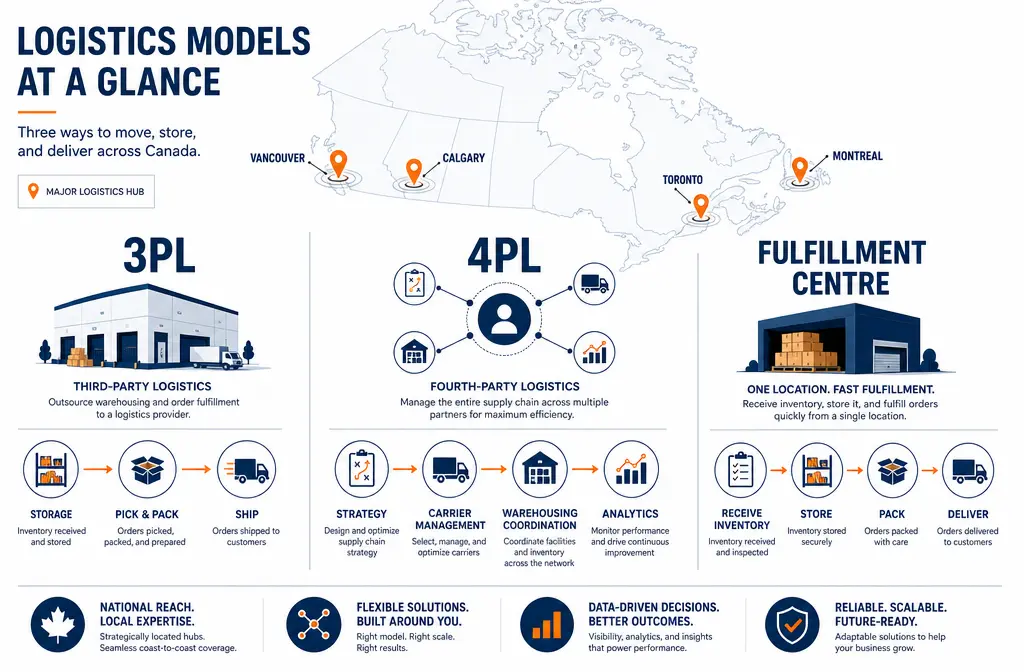
These three terms get used interchangeably, but they mean different things — and confusing them can lead to hiring the wrong type of provider.
| Term | What It Does | Best For |
|---|---|---|
| 3PL (Third-Party Logistics) | Warehousing, fulfillment, shipping, sometimes freight and customs | Most SMBs outsourcing fulfillment |
| 4PL (Fourth-Party Logistics) | Manages your entire supply chain, including other 3PLs | Larger businesses with complex, multi-provider logistics |
| Fulfillment Centre | Focused specifically on e-commerce order picking, packing, and shipping | DTC e-commerce brands with high order volume |
A fulfillment centre is technically a type of 3PL, but it’s narrower in scope. It’s built for speed and e-commerce volume — not for freight forwarding or customs clearance.
A 4PL sits above all of this. It acts as a supply chain manager, coordinating multiple 3PLs, carriers, and vendors on your behalf. Most SMBs don’t need a 4PL — the added management layer adds cost and complexity that only makes sense at significant scale.
Choose a 3PL if you need warehousing plus fulfillment, and possibly cross-border shipping or customs support. Choose a fulfillment centre if you’re a pure-play e-commerce brand with straightforward DTC orders and no B2B complexity.
How Much Does It Cost to Use a 3PL in Canada?
There’s no single answer, but there is a predictable fee structure. Most Canadian 3PL providers charge across four main categories:
- Receiving fees: Charged when your inventory arrives at the warehouse (per pallet, per hour, or per unit).
- Storage fees: Monthly charges based on the space your inventory occupies (per pallet, per bin, or per cubic foot).
- Pick-and-pack fees: A per-order or per-item fee for pulling items from shelves and packing the box.
- Outbound shipping: The actual carrier cost to deliver to your customer, sometimes marked up, sometimes passed through at cost.
Some providers also charge for account setup, software integration, returns processing, kitting, and special handling.
Rough benchmarks for Canadian SMBs (estimates based on market research, actual quotes will vary):
- Storage: $15–$35 per pallet per month
- Pick-and-pack: $2–$5 per order (single-item), plus $0.25–$1.00 per additional item
- Receiving: $25–$50 per pallet
The biggest mistake here is comparing 3PLs on storage cost alone. A provider with cheap storage but high pick-and-pack fees can end up costing far more than a slightly pricier competitor with better all-in rates. Always model your total monthly cost based on your actual order volume and SKU count. [2]
Also factor in what you’re currently spending on warehouse rent, labor, packaging materials, and carrier rates. For many SMBs, a 3PL is cost-neutral or cheaper once all those hidden in-house costs are counted.
When Is the Right Time to Switch to a 3PL in Canada?
Most businesses wait too long. By the time they’re seriously shopping for a 3PL, they’ve already spent months shipping from a garage, a rented storage unit, or an office corner — and it’s slowing everything down.
Watch for these signals:
- You’re shipping more than 100–200 orders per month and fulfillment is taking multiple hours a day.
- Shipping errors are increasing — wrong items, wrong addresses, late deliveries.
- You can’t take a day off without orders backing up.
- You’re turning down sales channels (like wholesale or retail) because you can’t handle the volume.
- Your carrier rates are uncompetitive because you don’t have the volume to negotiate better pricing.
- You’re expanding into new regions — shipping from one location across Canada is expensive and slow without a multi-node fulfillment network.

There’s also a lower-volume case for 3PL Canada: if you’re a new brand launching a product and you don’t want to invest in warehouse space upfront, some 3PLs will take on smaller accounts with low minimums. InterFulfillment, for example, has positioned itself around DTC and crowdfunding brands — including being named a Kickstarter Expert Partner in 2026 — which signals a focus on early-stage and growing businesses. [5]
What Should a Small Business Look for When Choosing a Canadian 3PL?
The best 3PL for your business depends on your specific situation — your sales channels, order volume, product type, and where your customers are. That said, there are six criteria that matter for almost every SMB. [2][3]
1. Geographic coverage
Does the provider have warehouses in the right cities? A dual-hub setup (Toronto + Vancouver) can cover roughly 90% of Canada’s population within two days. If most of your customers are in one region, a single well-placed warehouse may be enough.
2. Technology integration
Your 3PL’s warehouse management system (WMS) needs to connect directly with your sales channels — Shopify, WooCommerce, Amazon, wholesale EDI, whatever you’re using. Manual order uploads are a red flag.
3. Carrier relationships and shipping rates
A good 3PL has negotiated rates with multiple carriers (Canada Post, Purolator, FedEx, UPS, and regional carriers). You should benefit from those rates. Ask to see sample shipping cost comparisons before you sign.
4. Customs and cross-border capability
If you’re importing inventory or shipping cross-border, your 3PL needs strong customs clearance workflows. The CBSA requires complete cargo and invoice data for each individual e-commerce order — providers without proper data systems create clearance delays and compliance risk.
5. Scalability
Can they handle your peak season without degrading service? Ask about their busiest period (usually Q4) and how they staff for it.
6. Transparency on fees
Get a full fee schedule in writing before signing. Ask specifically about receiving fees, returns processing, minimum monthly charges, and what happens if you want to leave (exit fees, inventory return costs).
Quick decision rule: If a 3PL can’t show you a live demo of their tracking portal and walk you through exactly how an order flows from your store to your customer’s door — keep looking.
3PL Canada vs. Amazon FBA: Which Makes More Sense for SMBs?
Amazon FBA is not a 3PL replacement — it’s a marketplace fulfillment tool. For many Canadian sellers, it’s a useful channel, but it comes with trade-offs that have become more significant in 2026.
Amazon’s 2026 fee changes for Canadian sellers include a 3.5% fuel and inflation surcharge (effective April 17, 2026), plus ongoing adjustments to fulfillment fees by product size tier. These changes make FBA less predictable as a cost model, especially for lower-margin products.
Use Amazon FBA if:
- You sell primarily on Amazon.ca and want Prime eligibility.
- Your products are standard-size, fast-moving, and high-margin.
Use a dedicated Canadian 3PL if:
- You sell across multiple channels (your own website, wholesale, retail).
- You want control over packaging and unboxing experience.
- You need to ship B2B orders with custom labeling or pallet requirements.
- You want predictable, transparent pricing without marketplace dependency.
Many growing Canadian brands use both: FBA for their Amazon channel, and a 3PL for everything else. That’s a reasonable approach — just make sure your inventory isn’t split in a way that creates stockout risk on either side.
What Are the Most Common Mistakes Businesses Make When Hiring a 3PL?
Getting this decision wrong is expensive. Here are the mistakes that come up most often — and how to avoid them. [2][7]
Choosing on price alone. The cheapest 3PL quote rarely stays cheap. Low storage rates often come with high pick fees, minimum monthly charges, or poor carrier rates. Model your full monthly cost before deciding.
Not checking technology compatibility first. Discovering your 3PL’s system doesn’t integrate with Shopify after you’ve shipped your inventory there is a painful and costly problem. Confirm integrations before you sign anything.
Skipping the reference check. Ask for two or three current client references in a similar business category. A 3PL that’s great for automotive parts may be a poor fit for fragile cosmetics.
Ignoring the contract exit terms. Some 3PLs charge significant fees to retrieve your inventory if you want to leave. Read the termination clause carefully.
Underestimating onboarding time. Most 3PL transitions take four to eight weeks to fully stabilize — integrations, inbounding inventory, testing orders. Plan for this before your peak season, not during it.
Not thinking about returns. Returns processing (reverse logistics) is often an afterthought. Ask specifically how the provider handles returns, what condition assessment looks like, and what the per-return cost is.
How to Evaluate and Onboard a Canadian 3PL: A Step-by-Step Process
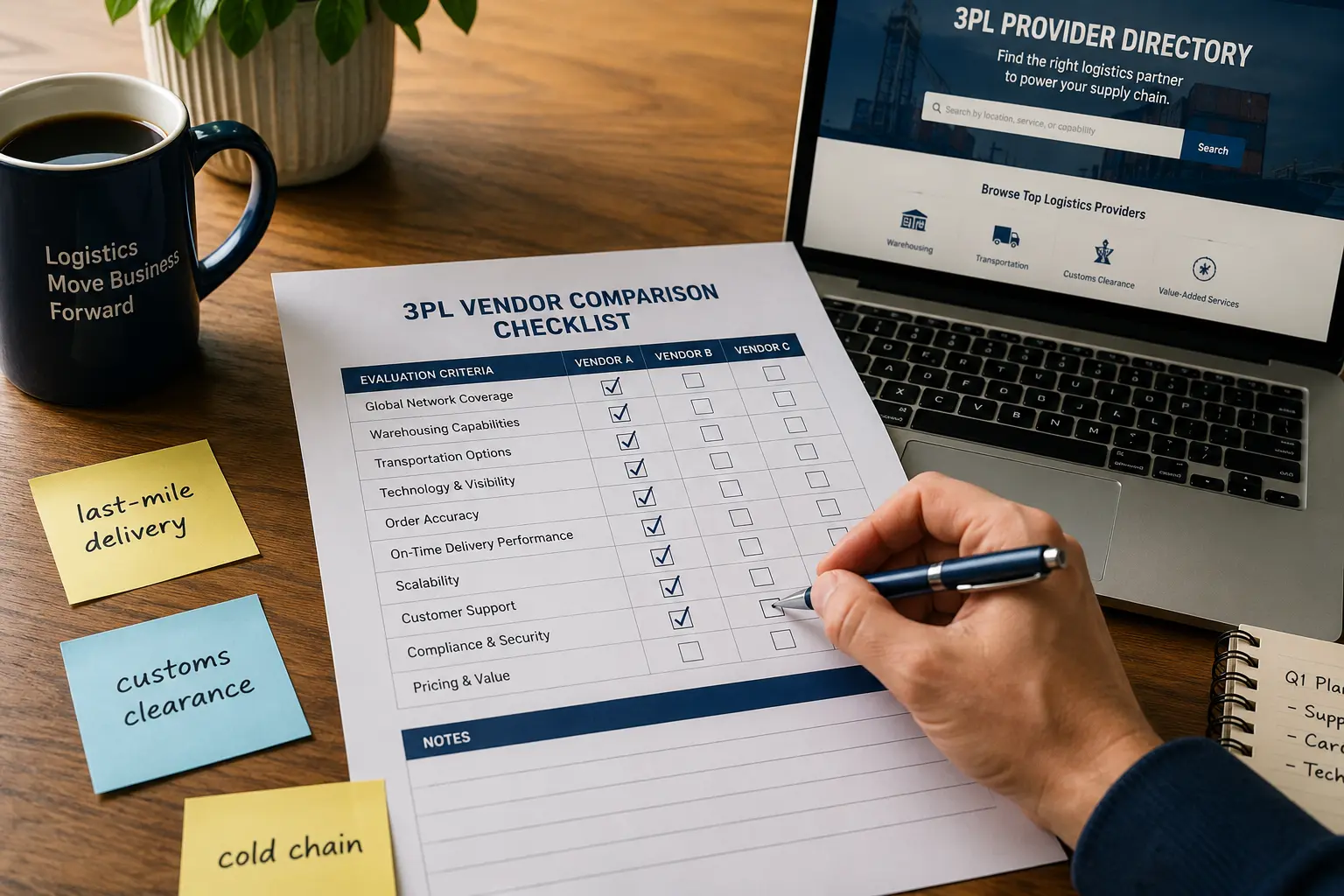
A structured approach here saves a lot of pain later. [2]
- Define your requirements — monthly order volume, SKU count, average order size, product dimensions/weight, special handling needs (cold chain, fragile, hazmat), and target delivery zones.
- Research providers with relevant experience in your product category and sales channels.
- Request proposals from at least three providers. Use the same order volume assumptions for each so you can compare apples to apples.
- Ask for a demo of their WMS and tracking portal.
- Check references — specifically ask about peak season performance and how they handle errors.
- Negotiate the contract — pay attention to minimum commitments, fee escalation clauses, and exit terms.
- Run a pilot if possible — start with a portion of your SKUs or a single sales channel before fully transitioning.
- Monitor KPIs for the first 90 days: order accuracy rate, on-time ship rate, inventory accuracy, and inbound receiving time.
Conclusion: Finding the Right 3PL in Canada Takes More Than a Google Search
The Canadian 3PL market is growing and competitive, with providers ranging from national networks with multiple distribution centers to niche specialists focused on cold chain logistics, crowdfunding fulfillment, or cross-border shipping. [9]
The right partner for your business isn’t necessarily the most well-known name. It’s the provider whose warehouse locations, technology stack, carrier relationships, and fee structure match where your business is today — and where it’s going in the next two to three years.
Your next steps:
- Map your current fulfillment costs honestly (labor, rent, packaging, carrier rates).
- Define your must-have requirements before you start talking to providers.
- Get at least three proposals and compare total monthly cost, not just one fee category.
- Use a directory like LogisticsSearch.ca to find and compare Canadian 3PL providers by region and specialty — so you’re not starting from scratch.
The logistics decision you make now will either free up your team to grow the business or create a new set of operational headaches. Take the time to get it right.
Frequently Asked Questions
What does 3PL stand for?
3PL stands for third-party logistics. It refers to a company that manages warehousing, order fulfillment, and shipping on behalf of another business.
Is a 3PL worth it for a small business in Canada?
Yes, for most businesses shipping more than 100–200 orders per month. A 3PL gives you access to negotiated carrier rates, professional warehouse operations, and more time to focus on growth — without the capital cost of running your own warehouse.
How do I find a 3PL in Canada?
Start with a Canadian logistics directory like LogisticsSearch.ca, which lets you filter by region, service type, and specialty. Also ask for referrals from other business owners in your product category.
Can a 3PL handle cross-border shipping into Canada?
Yes, but not all 3PLs are equally equipped for it. Cross-border shipments require complete customs data per order under CBSA rules. Choose a provider with documented customs clearance workflows and experience with Canadian import compliance.
What’s the minimum order volume most Canadian 3PLs require?
It varies. Some providers have no minimums and cater to early-stage brands; others require 500+ orders per month. Always ask upfront — and factor in minimum monthly storage or service fees, which can add up even at low volumes.
How long does it take to set up with a new 3PL?
Most onboarding processes take four to eight weeks from contract signing to fully live operations. This includes software integration, inbounding inventory, and testing order flows. Don’t start a 3PL transition in October if your peak season is November.
What’s the difference between a 3PL and a freight forwarder?
A freight forwarder moves goods in bulk between locations (factory to warehouse, port to distribution center). A 3PL handles the warehousing and last-mile delivery of individual orders to end customers. Some providers offer both services.
Do Canadian 3PLs handle returns?
Most do, but returns processing is often a separate fee. Ask specifically about the returns workflow, condition assessment process, and per-return cost before signing.
What technology should a good Canadian 3PL have?
At minimum: a warehouse management system (WMS) with real-time inventory visibility, direct integrations with major e-commerce platforms (Shopify, WooCommerce, Amazon), and an order tracking portal for you and your customers.
Is Amazon FBA a good alternative to a 3PL in Canada?
For Amazon-only sellers, FBA can work well. But 2026 fee changes — including a 3.5% fuel surcharge — have made FBA less cost-predictable. For multi-channel brands, a dedicated Canadian 3PL gives more flexibility and control over the customer experience.
References
[1] 3PL Fulfillment Companies – https://stallion.ca/blog/3pl-fulfillment-companies/
[2] Best Canadian 3PL Companies: How To Choose The Right Partner In 2026 – https://evolutionfulfillment.com/best-canadian-3pl-companies-how-to-choose-the-right-partner-in-2026/
[3] Best 3PL Canada – https://www.gobolt.com/blog/best-3pl-canada/
[5] InterFulfillment Named A Kickstarter Expert Partner For 3PL Order Fulfillment In Canada – https://markets.businessinsider.com/news/stocks/interfulfillment-named-a-kickstarter-expert-partner-for-3pl-order-fulfillment-in-canada-1036087299
[7] 3PL Recommendations – https://www.reddit.com/r/canadasmallbusiness/comments/143nz5u/3pl_recommendations/
[8] What Is A 3PL And How Can They Benefit Your Business – https://www.chrobinson.com/en-us/resources/blog/what-is-a-3pl-and-how-can-they-benefit-your-business/
[9] Canada 3PL Market – https://www.mordorintelligence.com/industry-reports/canada-3pl-market